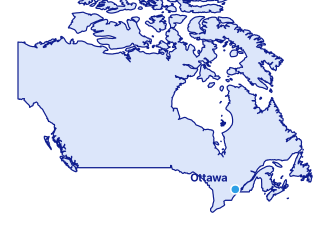
Here's what the map actually shows.
A Country That Bet on Global Trade — And Won
While other nations built walls, Canada built bridges.
Over the last three decades, Canada quietly negotiated 15 free trade agreements spanning 51 countries — covering the United States, the entire European Union, the United Kingdom, Japan, Australia, Vietnam, Chile, Peru, and more. The result: any business operating from Canadian soil gets preferential market access to over 1.5 billion consumers and nearly two-thirds of global GDP.1
This isn't an accident. It's a deliberate national strategy — and it's one of the best‑kept secrets in global business.1
The Numbers Behind the Platform
Canada's GDP stood at about USD 2.24 trillion in 2024 — the 9th largest economy in the world — growing at roughly 1.6% annually, with strong contributions from mining, oil and gas, real estate, finance, and services. Per capita GDP sits around USD 54,000, placing Canada firmly among high‑income consumer markets.2
The population of just over 40 million is concentrated, high‑income, and highly educated — but the real story isn’t the domestic population; it’s the 1.5 billion consumers accessible through Canada's FTA network in some of the richest regions on earth.3
The Currency Angle: A Structural Cost Advantage
The Canadian dollar (CAD) typically trades at a discount to the US dollar — often in the 0.70–0.80 USD range — and that creates a structural edge for businesses operating from Canada.4
Companies that earn revenue in USD (or price in USD globally) while paying costs in CAD enjoy a built‑in cost arbitrage across talent, real estate, and local operations.
As a commodity‑linked currency, the CAD moves with oil and metals prices; resource exporters benefit from a natural hedge between export prices and currency movements.5
With the US as Canada’s largest trading partner, a high share of trade is effectively USD‑linked, giving Canadian‑based firms direct exposure to dollar‑denominated contracts and pricing.6
For global operators, Canada often delivers G7‑level stability at a relative cost discount.7
What Canada Actually Brings to the Table
Canada’s economy is services‑led, but its global competitive edge is grounded in resource depth, advanced industry, and technology.
Natural Resources & Energy – Resource industries account for about 10% of domestic GDP but roughly 50% of total exports, highlighting their global demand intensity. Canada ranks among the top three producers of uranium, potash, nickel, zinc, and cobalt — all critical for the clean energy transition — and is the world’s 6th largest energy producer with major oil, gas, and hydro assets.8
Finance & Professional Services – Finance, insurance, and real estate collectively generate one of the largest shares of GDP after broad services; Toronto is a major North American financial hub with a highly regulated, stable banking system.9
Technology & AI – Canada hosts one of North America’s key tech corridors, with world‑class AI and deep learning clusters in Toronto, Montréal, and Vancouver, and strong ties between universities and industry.1
Agriculture & Food – A top global exporter of wheat, canola, pulses, and seafood; agriculture and agri‑food continue to contribute positively to growth, especially in Western Canada and Atlantic provinces.9
Advanced Manufacturing & Aerospace – More than 1.7 million people are employed across ICT, robotics, 3D printing, and aerospace, with major clusters in Ontario and Québec.1
Digital Media & Entertainment – The world’s third most‑filmed country, with leading capabilities in animation, VFX, and game development, supported by competitive cost structures and incentives.1
This is a rare combination: resource superpower, services hub, and advanced industrial base in one.
Ease of Doing Business: High Trust, High Predictability
Canada offers a business environment that consistently ranks among the most open and predictable globally.
In the last World Bank Ease of Doing Business index, Canada ranked 23rd out of 190 economies.2
On the World Bank’s Business Ready metrics, Canada scores around 88% on utility services (top 20% globally), 75 on public services (top 20%), and 74 on operational efficiency (top 20%).10
Canada ranks 14th worldwide in economic freedom, reflecting strong rule of law, sound money, and open markets.5
Practical advantages for operators include:
Fast, low‑friction incorporation at the federal level via Corporations Canada, with nationwide operating rights.10
Transparent, common‑law based legal systems (in most provinces) with strong contract enforcement and IP protection.
Stable macroeconomic and political environment, with prudent financial regulation and strong public institutions.3
Trade Architecture: One Address, Global Reach
Canada’s FTA architecture is its quiet superpower.
CUSMA/USMCA – Deeply integrated access to the USD 30 trillion North American market, with harmonised rules across Canada, the US, and Mexico.1
CETA – Comprehensive agreement with the European Union, providing preferential access to 27 EU member states and more than 447 million consumers.1
CPTPP – One agreement covering Japan, Australia, Singapore, Malaysia, Vietnam, Chile, Peru, Mexico, New Zealand, and Brunei — most of the Pacific growth corridor.1
From a single Canadian entity, companies can serve customers across North America, Europe, and the Asia‑Pacific under some of the most favourable market access terms available anywhere.1
Canada’s combination of high‑income demand, a favourable currency, deep resources, advanced industry, a stable business environment, and one of the world’s best FTA networks makes it far more than a “nice” market — it makes it a serious, multi‑dimensional global business platform.2
Aculeap exists for one reason — to make sure you’re on the right side of that bridge.
The platform is open. Are you ready to build on it?
Is Canada Right for My Business?
Canada market entry FAQ
Canada seems small compared to the US. Why should I prioritise it?
The domestic market of 40 million is not the primary case for Canada — the FTA architecture is. A Canadian entity gives you preferential market access to the US (via USMCA), the entire EU (via CETA), Japan, Australia, Singapore, Vietnam, Chile, Peru, and more — all from one address. For businesses that want North American presence with global trade reach, Canada is often a smarter first step than going directly into the US market, at a fraction of the cost and complexity.11
Should I enter Canada or the US first?
This is one of the most common questions we hear. The honest answer depends on your product, your capital, and your risk tolerance. Canada offers lower entry costs, a familiar legal environment for Commonwealth-country founders, a more predictable regulatory landscape, and — critically — it gets you inside the USMCA zone. Many SMEs use Canada as a beachhead to learn North American buyer behaviour, build pipeline, and validate messaging before committing to the higher-cost, more competitive US market. Others go directly to the US if their category, capital, and ICP demand it. We help you make this decision with data, not guesswork.
Is Canada genuinely open to foreign businesses, or is it harder than it looks?
Canada is genuinely open — in fact, it is one of the more straightforward G7 markets for foreign entry. The legal system is transparent and common-law based (except Québec, which uses civil law). Business registration is fast, and most provinces have removed Canadian-resident director requirements. The main complexity is the federal-provincial layering: operating across multiple provinces requires understanding different tax regimes, employment laws, and registration requirements.121311
Do I need a Canadian resident director to incorporate?
This is a frequently misunderstood point. Under the Canada Business Corporations Act (federal), at least 25% of directors must be Canadian residents. However, several provinces — including British Columbia and Ontario — have removed the Canadian-resident director requirement entirely. For most foreign companies, incorporating provincially in BC or Ontario eliminates this barrier entirely. We navigate this routinely.1213
What is the tax rate for a foreign-owned Canadian corporation?
Canadian-Controlled Private Corporations (CCPCs) enjoy a preferential small business tax rate (currently around 9% federally on the first CAD 500,000 of active income). However, if your corporation is foreign-controlled — which it will be if your ownership comes from outside Canada — it does not qualify as a CCPC and pays the general corporate rate, currently 15% federally, plus provincial rates (typically 8–16%), for a combined effective rate in the mid-20% range. Tax treaty planning between your home country and Canada can significantly reduce withholding taxes on dividends, royalties, and management fees paid to the parent. We structure this from day one.12
A US LLC owning a Canadian company — is that a problem?
It can be. A US LLC owning a Canadian entity (often called a "Canco") is workable, but you need to be able to declare treaty benefits under the Canada–US tax treaty to avoid a 25% withholding tax on dividends, interest, management fees, and royalties flowing from Canada to the US LLC. If the US LLC cannot access treaty benefits (e.g., because it is a disregarded entity for US tax purposes), you face full withholding. This is a very common structuring trap that we help clients avoid before it becomes expensive.12
What about federal vs. provincial incorporation — which should I choose?
Federal incorporation gives you the right to operate under the same name in all provinces, a stronger national credibility signal, and is generally preferred for companies that plan to operate across multiple provinces or raise capital. Provincial incorporation (in BC or Ontario especially) is simpler and faster, removes the resident-director requirement, and works well for companies initially focused on one province. Most of our cross-border clients start with a federal corporation or a BC/Ontario corporation depending on their operating geography.1113
How long does incorporation take in Canada?
Federal incorporation via Corporations Canada can be done in two to five business days online. Provincial incorporations vary — Ontario and BC are typically two to three days. What takes longer is the downstream work: CRA registration (Business Number, GST/HST, payroll accounts), provincial tax registration, opening a business bank account, and getting compliant with applicable employment law in your operating province. We manage the full workflow.14
Is opening a Canadian business bank account hard for foreign-owned entities?
It is harder than most founders expect. Canadian banks (RBC, TD, BMO, Scotiabank, CIBC) require in-person visits in many cases, a Canadian address, and extensive KYC documentation for foreign-controlled entities. Digital banking alternatives (Wise Business, Mercury Canada) have improved the landscape, but for most B2B and professional services firms, a major bank account is important for credibility. We manage this process — documentation, bank selection, and follow-through — so you can transact from day one.
Do I need to protect my IP separately in Canada?
Yes. IP rights registered in the US, UK, India, or elsewhere are not automatically recognised in Canada. Canada operates a first-to-file system for patents and trademarks — meaning if you plan to sell products or services in Canada, you should file for Canadian IP protection before entering the market. We flag this as part of every market entry engagement and connect you with Canadian IP counsel where required.11
What are the main compliance obligations after I incorporate?
GST/HST registration once revenue exceeds CAD 30,000 in any 12-month period (and possibly provincial sales taxes in some provinces)
Provincial employer health tax registration in some provinces (e.g., Ontario, BC)
Transfer pricing documentation if you have intercompany transactions with a related foreign entity
We deliver a jurisdiction-specific compliance calendar so nothing falls through the cracks.
How different is the Canadian buyer from the US buyer?
More different than most founders expect. Canadian B2B buyers — particularly in enterprise and government — tend to make decisions more slowly, are more relationship-oriented, and are more risk-averse than US counterparts. Trust-building matters more upfront. Pricing expectations can be lower (partly a CAD/USD effect). And there are meaningful cultural and market differences across regions — Ontario and BC are very different markets from Québec (which requires French-language compliance) and Alberta. We build a Canada-specific ICP, buyer journey, and channel strategy rather than copying what works in the US or home market.
Should we target English Canada only, or also Québec?
For most SMEs entering Canada for the first time, English Canada (Ontario, BC, Alberta, Atlantic provinces) is the natural starting point. Québec is a significant market — roughly 23% of Canada's population — but requires French-language compliance under the Charter of the French Language (Bill 96), which imposes meaningful obligations on businesses operating there, including website language, contracts, and internal communications. We recommend entering Québec in a second phase with proper language compliance built in.
Do we need a Canadian office or physical presence to sell into Canada?
No. You can sell to Canadian customers from outside Canada without a physical presence, provided you comply with applicable GST/HST registration requirements once you exceed the threshold. However, having a Canadian entity, a registered address, and local references significantly increases buyer trust — especially in government, financial services, and enterprise segments. Most of our clients operate with a virtual office and a fractional executive on the ground in the first 12 months before committing to physical space.
How important is government as a customer in Canada?
Very important — and very different from private-sector selling. Government procurement at federal and provincial levels is a significant market for many sectors (IT, professional services, healthcare, construction, clean energy). But it requires supplier registration (SAP/ProServices, provincial registries), clearances, and often a local entity. We help clients who want to access Canadian government procurement build the right structure and supplier profile from day one.
What is the best channel strategy for entering Canada?
This is highly sector-dependent. Direct sales work well for high-value B2B services. Distributor/reseller networks are common in manufacturing, food, and consumer goods. Digital and e-commerce channels work well for lower-ticket B2C and SMB products. Partnership with a Canadian firm (VAR, agency, or referral partner) is often the fastest way to build credibility and pipeline in year one. We map the right route-to-market for your specific category, margin waterfall, and buyer profile.
How do we generate qualified pipeline in Canada quickly?
Our AI Growth Engine activates within 72 hours of onboarding — building a targeted ICP list, launching personalised multi-channel outbound (email and LinkedIn), and setting up your inbound funnel. Most clients begin seeing qualified Canadian pipeline within 30 to 45 days of activation. LinkedIn is particularly effective for B2B in Canada; cold email works well if sequences are personalised and compliant with Canada's Anti-Spam Legislation (CASL).
What is CASL, and does it affect our outbound sales in Canada?
Canada's Anti-Spam Legislation (CASL) is one of the strictest anti-spam laws in the world. It requires express or implied consent before sending commercial electronic messages (CEMs) to Canadian recipients, with meaningful fines for violations (up to CAD 10 million per violation for corporations). In practice, this means your outbound email strategy needs to be structured differently for Canada than for the US. Our AI Growth Engine sequences are CASL-compliant by design — we do not treat Canada like a US campaign with a different country code.15
The CAD is weaker than the USD. How does that affect our business in Canada?
If you are earning in CAD and repatriating to USD, the exchange creates a haircut on profits. If you are earning in USD (or pricing globally in USD) while paying costs in CAD, the discount works in your favour — you are effectively paying for Canadian talent, real estate, and services at a lower USD cost than the equivalent in the US. For most foreign SMEs entering Canada, this currency structure is a net positive, especially for businesses with a cost base in Canada and a revenue base priced in USD or globally.
Do Canadian banks or investors have any preference for how a foreign company is structured?
Yes. Canadian institutional investors and banks prefer to deal with incorporated Canadian entities rather than foreign branches or pass-through structures. For companies planning to raise capital from Canadian VCs or angels, a Canadian holding structure with clean share capital, shareholder agreements, and SRED (Scientific Research and Experimental Development) eligibility — if applicable — is significantly more attractive. We build the structure with your capital strategy in mind, not just day-one operations.
How do we hire Canadian employees as a foreign-owned entity?
Once you incorporate and obtain a CRA Business Number with a payroll account, you can hire employees in Canada. Employment law is provincially regulated — minimum wage, termination notice, vacation entitlements, and employment standards differ by province. Common-law applies in most provinces (except Québec, which uses civil law). Mis-hiring or mis-classifying contractors is one of the most expensive compliance mistakes foreign SMEs make. We guide you through the right structure, and where needed, can recommend an Employer of Record (EOR) for your first hires.11
Do we need a Canadian visa to run a Canadian business?
No. You can own and operate a Canadian corporation from outside Canada without a visa. However, if you want to be physically present in Canada to manage operations, meet clients, or hire staff, you need an appropriate work authorisation. Common pathways include the Intra-Company Transfer (ICT) work permit for employees of multinationals, the Start-up Visa for qualifying entrepreneurs, and the Owner-Operator LMIA pathway for business owners. We connect you with Canadian immigration counsel for visa structuring alongside your corporate setup.
Can a Fractional Executive help us build our Canadian market without a full-time hire?
Yes — and for most SMEs in the first 12 months in Canada, it is the right move. A Fractional Country Manager or Fractional CRO with Canadian market experience can open doors, build relationships, and execute the GTM motion without the CAD 180,000–250,000 cost of a full-time senior hire before you have validated the market. We place fractional executives with specific Canadian industry networks and relevant sector experience.
What specifically does Aculeap do for companies entering Canada?
End-to-end. We validate your Canadian opportunity and build your 90-day entry roadmap (Market Entry Strategy), set up your Canadian entity with the right federal or provincial structure, GST/HST, banking, and compliance calendar (International Corporate Structuring), activate your GTM with channel strategy, partner identification, CASL-compliant outbound, and sales playbook (GTM Execution), run your AI-powered growth engine (AI Growth Engine), and place fractional executives on the ground (Fractional Executive Network). You can engage us across all layers or start with the one that fits your current stage.
We are an Indian company. Is Canada a realistic market for us to enter?
Absolutely — and one of the most natural corridors. The Canada–India bilateral relationship is strong, the Indian diaspora is one of the largest and most economically active communities in Canada, and the Canada–India tax treaty creates planning opportunities. Indian companies in software, professional services, manufacturing, food, and financial services have built meaningful Canadian businesses. The Canada–India corridor is one Aculeap specifically focuses on, with playbooks, networks, and tax structuring experience built for exactly this path.12
How do we get started?
Book a free 30-minute discovery call. We will ask you about your home market, your Canadian hypothesis, your current structure (if any), your timeline, and your capital position — and give you an honest view of where you are, what you need, and what a sensible Aculeap engagement looks like.
Still have questions? Email us at 16 or use the live chat below.
Sources
- moet.gov — www.moec.gov.ae
- tradingeconomics — tradingeconomics.com
- budget.canada — www.budget.canada.ca
- mexc
- en.wikipedia — en.wikipedia.org
- international.canada — international.canada
- ainvest
- bdc — www.bdc.ca
- www150.statcan.gc — www150.statcan.gc
- worldbank — www.worldbank.org
- outsidegc
- reddit — www.reddit.com
- youtube — www.youtube.com
- canada
- wise — wise.com
- [email protected] — [email protected]
- GDP & GDP per capita: International Monetary Fund, World Economic Outlook (2025–26 estimates). imf.org
- Population: national statistical offices / United Nations (latest official estimate). population.un.org
- Safety — Global Peace Index 2025: Institute for Economics & Peace. economicsandpeace.org
- Safety — Safety Index 2026: Numbeo. numbeo.com
- Corporate tax (statutory headline rate): KPMG corporate tax rate tables. kpmg.com
- Trade agreements: national trade ministries / WTO Regional Trade Agreements database. wto.org
Country-snapshot figures reflect the latest available data (2024–2026) from the sources above; FX rates are live or pegged as noted. Figures are drawn from the sources above and reflect the latest available data at time of writing; we refresh market guides periodically. They are provided for general guidance and are not legal, tax, or financial advice.