
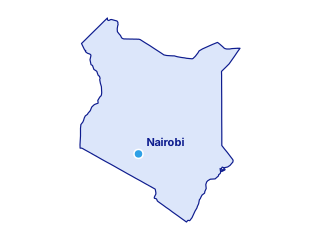
A 50+ Million Market Anchoring a Region
Kenya is not the largest African economy, but it is one of the most strategically positioned.
Population is around 52–54 million, making Kenya one of Africa’s top 10 most populous countries and the core market of the East African Community (EAC).1
Real GDP grew 4.7% in 2024 and 4.6% in 2025, down from 5.7% in 2023 but still solid compared to many peers.2
By the end of 2025, Kenya’s economy was worth about KES 17.6 trillion in nominal terms, with all major sectors posting positive growth.2
For companies looking at East Africa, Kenya is the natural base: strongest services hub, key logistics node, and a relatively diversified economy.
The Currency Angle: From Crisis to Managed Stability
The Kenyan shilling (KES) has just been through a major stress cycle — and a partial reset.
In Q1 2024, the shilling depreciated to record lows of KES 159.69, 151.87, and 137.35 per USD in January, February, and March respectively, driven by external debt pressures, FX shortages, and market panic.3
By early 2025, after policy tightening, external financing, and improved inflows, KES stabilised around KES 129.30 per USD, while import cover rose to about 4.7–5.1 months.3
Forecasts see USD/KES averaging roughly 132.3 in 2024 and 142.8 in 2025, with a “managed float” approach — market‑driven, but with central bank intervention to prevent extreme volatility.4
For businesses:
The worst of the panic phase appears past; the shilling is now in a more managed, less chaotic regime.
Exporters and FX‑earners (services, horticulture, tourism, outsourcing) benefit from a weaker KES, as foreign revenues convert into more local currency, while their costs (wages, local inputs) remain in shillings.4
Import‑heavy, KES‑revenue models still face FX risk and need active hedging and pricing strategies.
The shilling is not “safe” in the way a dollar‑pegged currency is, but it is moving from raw instability toward a managed, more predictable framework.
What Kenya Brings to the Table
Kenya’s economy rests on three key pillars: services, agriculture, and a smaller but important industrial base.
Services: The Largest Contributor
Services are the biggest contributor to GDP, followed by agriculture, with industry a distant third.52
Key services include:
Trade (wholesale and retail)
Transport and storage (which contributed 11.8% of GDP in 2025)
Financial and insurance activities
Information and communication
Nairobi is one of Africa’s leading financial and tech hubs, with a strong mobile money ecosystem (M‑Pesa) and a growing startup scene in fintech, logistics, and digital services.
Services are already the structural engine of GDP and jobs in Kenya’s urban economy.
Agriculture: The Backbone of Rural Output and Jobs
Agriculture accounts for about 20–30% of GDP depending on the measure and year. The Central Bank estimates around 20% of GDP, while other sources put it closer to 30%.6
Between 2021 and 2024, agriculture contributed around 28% of GDP and employed roughly 40% of the labour force, making it a central pillar of rural livelihoods.1
Agriculture, forestry, and fishing contributed 23.2% of GDP in 2025 — the single largest sectoral share.2
The sector contributes more than 60% of export earnings and about 45% of government revenue, and accounts for about 80% of national employment directly or indirectly.7
For agribusiness, inputs, processing, cold chain, logistics, and agri‑tech, Kenya offers scale and impact in equal measure.
Industry: Small, But Strategically Important
Industry’s share of GDP is smaller than services and agriculture, with manufacturing focused on food processing, beverages, textiles, cement, and basic consumer goods.5
Industrial growth is closely tied to domestic demand, infrastructure projects, and export processing in sectors like horticulture and textiles (EPZs).
Industry is not yet the main story, but it is an area where policy and investors want to see more.
Ease of Doing Business: Mid‑Pack, But Improving
On paper, Kenya sits in the middle of the global pack — with some real reform progress.
Kenya ranked 56th out of 190 economies in the World Bank’s last Ease of Doing Business index (2019), improving from 61st in 2018 and from an average rank of 98 over 2008–2019.8
Areas of strength:
Starting a business (significant improvement via e‑registration)
Getting credit and protecting minority investors
Resolving insolvency, relative to regional peers8
Ongoing challenges:
Electricity access and reliability
Enforcing contracts and judicial delays
Some regulatory rigidities and the dominance of state‑linked or politically connected firms in certain sectors2
A recent World Bank product market regulation study flagged Kenya as one of the more restrictive business environments among middle‑income peers, with heavy regulation and state‑owned enterprises limiting competition. That means relationships, structuring, and partner selection matter a lot.2
A Gateway Between Landlocked Markets and the World
Kenya’s value is as much about geography as it is about sector breakdown.
From a Kenya base, companies can:
Serve a 50‑plus‑million domestic market and act as a hub for neighbouring landlocked countries (Uganda, Rwanda, South Sudan, parts of DR Congo) via the Northern Corridor and the Port of Mombasa.5
Plug into the East African Community (EAC), tapping a regional market of 180+ million people with growing integration around trade and movement.5
Leverage Nairobi’s role as a regional HQ location for multinationals, NGOs, and development agencies, which creates dense networks in finance, professional services, and logistics.
Combine agriculture and services plays — for example, building agri‑value chains that integrate production, processing, logistics, finance, and digital platforms.7
Kenya is not a mega‑market, but it is a strategic node for East Africa — especially for logistics, finance, tech, and agri‑value chains.
Kenya is noisy: FX swings, regulatory complexity, and a still‑developing business environment. But beneath that, the structure is real: a 50‑plus‑million market, GDP growing around 4.5%, services and agriculture jointly driving most output, a currency moving from chaos toward managed stability, and a geographic position that makes it the natural gateway to East Africa.325
For companies willing to manage volatility and complexity in exchange for regional access and early positioning, Kenya is less a risk story and more a leverage story.
Aculeap exists for one reason — to make sure you’re on the right side of that bridge.
The platform is open. Are you ready to build on it?
Is Kenya Right for My Business?
Kenya market entry FAQ
Is Kenya too small or too risky to matter in a global plan?
Kenya is a 52–54 million‑person market, with GDP growing around 4.6–4.7% in 2024–2025 and a services‑plus‑agriculture structure that drives most output.526 It anchors the East African Community (EAC) and acts as the primary services and logistics hub for landlocked neighbours like Uganda, Rwanda, and South Sudan.5 If you want an East Africa play with real scale and cross‑border leverage, Kenya is the natural base.
Should we treat Kenya as a domestic market or a regional gateway?
Both — but as with Nigeria and Brazil, sequence matters. In the first phase, Kenya is a domestic anchor: Nairobi and Mombasa give you a concentrated services, finance, and tech demand base plus deep agricultural value chains.57 In the second phase, it becomes a gateway, using the Port of Mombasa and the Northern Corridor to reach Uganda, Rwanda, parts of DR Congo, and South Sudan, and leveraging EAC integration into a 180+ million‑person regional market.54
Has the Kenyan shilling stabilised, or is the FX situation still chaotic?
The panic phase has eased, but KES is not a “set‑and‑forget” currency yet. After hitting record lows above KES 150–160 per USD in early 2024, policy tightening, external financing, and improved inflows helped bring the shilling toward the 120s–130s and stabilise reserves at about 4.7–5.1 months of import cover.34 Forecasts see KES in a “managed float” regime, averaging roughly 132–143 per USD over 2024–2025 — volatile, but more predictable than in the crisis phase.4 Exporters and FX‑earners benefit; import‑heavy, KES‑only models must actively price FX risk.
Can we realistically hedge or structure around KES risk?
Contracting in USD or EUR where customers and regulators allow.
Using natural hedges: matching FX inflows (tourism, outsourcing, exports) with FX obligations.
Keeping strategic reserves in hard currency and converting to KES as needed.
You won’t eliminate FX risk, but we build it into your commercial model and capital structure so it’s a parameter, not a surprise.
Can a foreigner own 100% of a Kenyan company?
Yes. A private limited company (LLC) — the most common structure for local and foreign entrepreneurs — can be 100% foreign‑owned. No minimum share capital is legally required to incorporate, though in practice at least KES 100,000 (~USD 1,000) is recommended and often required for certain licences or visas. Foreigners can also register branch or representative offices of an existing foreign company.9210
What are the main ways a foreign investor can operate in Kenya?
Kenyan private limited company (LLC) — Separate legal entity; most flexible and common; allows 100% foreign ownership.
Branch office of a foreign company — Extension of a foreign legal entity; used when HQ wants direct control.
Representative office — For marketing and liaison; cannot conduct revenue‑generating activities.
Export Processing Zone (EPZ) company — For export‑oriented manufacturers or services, with tax and customs incentives.
For most SMEs, a private limited company is the default; EPZ status makes sense only if you’re truly export‑led.
How do we actually register a company as foreigners? Can we do it remotely?
Yes — registration is fully online via the eCitizen portal. Foreigners must first create an eCitizen account using their passport, then:1129
Reserve a company name with the Registrar of Companies.
Complete incorporation forms (CR1, CR2, CR8) and provide a statement of nominal capital.
Upload director and shareholder details, including passport copies and KRA PINs where required.
Submit and pay fees online.
Receive the Certificate of Incorporation electronically.
It is now possible to register as sole shareholder and sole director from abroad, but you must still provide a Kenyan registered address and will later need a KRA PIN and, if residing, a work permit.122
Is there a minimum investment amount for foreign investors?
For basic company registration, there is no statutory minimum, though KES 100,000 is a common practical floor. For larger foreign investors seeking an Investment Certificate from the Kenya Investment Authority (KenInvest) — which gives facilitation and visa advantages — the threshold is typically USD 100,000 in planned investment. Some visas (e.g., certain entrepreneur permits) also expect investments above USD 100,000.213
What tax identifiers and registrations do we need?
Obtain a KRA PIN (tax ID) for the company and, in many cases, for directors.
Register for VAT (16%) once you cross the turnover threshold or choose to register voluntarily.
Register as an employer with NSSF (pensions) and NHIF (health).
Apply for county‑level Single Business Permits for your physical location.
Foreign investors residing in Kenya need their own KRA PINs and work/residence permits. For non‑resident investors, a tax agent and KenInvest endorsement may be required, especially above KES 10 million investment.12
Can I live in Kenya and run my company, or do I need a separate visa?
You need a proper work and residence permit — owning a company does not automatically give you the right to live and work in Kenya. Common pathways include:212
Class G investor permit for investments typically above KES 10 million (around USD 80,000–100,000) with proof of capital and business plan.12
Work permits tied to employment by the Kenyan company for specialist roles.
For larger investment (USD 100,000+), an Investment Certificate from KenInvest strengthens your case and streamlines interactions with other agencies. We integrate immigration planning into the corporate structure so you don’t get stuck with a company you can’t legally run on the ground.13
What are the main compliance obligations for a Kenyan company?
Annual filing of returns and financial statements with the Registrar of Companies.
Corporate income tax at 30% (resident companies).
VAT (16%) filing if registered.
PAYE (pay‑as‑you‑earn) payroll taxes, plus NSSF and NHIF contributions.
County‑level single business permits and, where needed, sector‑specific licences (KEBS, CBK, EPRA, etc.).
The eCitizen and KRA systems make many filings digital, but navigating them as a foreigner still requires local tax and legal support. We build you a compliance calendar and align reliable local professionals early.
How “easy” is it to operate day‑to‑day?
On headline indices, Kenya is mid‑pack globally but better than many regional peers: 56th out of 190 in the last Doing Business ranking, with particular improvements in starting a business, getting credit, and protecting minority investors.8 Pain points remain in power reliability, contract enforcement, and regulatory complexity, especially where state‑linked or politically connected firms dominate.2 Success depends heavily on choosing the right sector, county, and local partners.14
Which sectors make the most sense for foreign SMEs in Kenya?
Given the structure of the economy, strong lanes include: 5710
Agriculture & agri‑value chains — Inputs, mechanisation, irrigation, storage, cold chain, processing, and fintech for farmers.
Tech and digital services — Fintech, payments, logistics tech, healthtech, and B2B SaaS, leveraging mobile money penetration and Nairobi’s startup ecosystem.
Logistics & trade — Port‑adjacent services, regional trucking, warehousing, and cross‑border e‑commerce flows.
Tourism & hospitality — Experiences, niche travel, and tech‑enabled tourism services.
Professional services — Legal, consulting, engineering, and development‑sector services anchored in Nairobi.
We map your capabilities to where Kenya has both structural demand and a realistic path to execution.
Nairobi vs. Mombasa vs. elsewhere — where should we base ourselves?
For most foreign entrants, Nairobi is the default HQ: it’s the financial, tech, and services capital, and a regional HQ node for many multinationals and NGOs.5 Mombasa is key if you are port‑ and logistics‑heavy. Agricultural and industrial operations may be better placed in counties like Nakuru, Kiambu, Uasin Gishu, or others, depending on crops and infrastructure. We often recommend Nairobi corporate HQ plus sector‑specific footprints elsewhere.10
What does Aculeap actually do for Kenya entry and scaling?
Market Entry Strategy — Decide if Kenya belongs in your first or second expansion wave, identify sectors and counties, and design a realistic 90‑day entry plan.
International Corporate Structuring — Coordinate eCitizen registration, local company or branch setup, KRA PINs, KenInvest engagement, tax and licence registrations, and banking.
GTM Execution — Build your Kenya and East Africa sales and partnership motion, focusing on specific verticals (agri, fintech, logistics, etc.) instead of “Kenya in general.”
AI Growth Engine — Use AI to map accounts, networks, and talent in Kenya and neighbouring EAC markets and prioritise the highest‑leverage opportunities.
Fractional Executive Network — Bring in East Africa‑experienced fractional leaders or advisors so you’re not navigating the ecosystem alone.
How do we get started with Aculeap for Kenya?
Book a 30‑minute Kenya discovery call. We’ll map your corridors (Africa, Gulf, India, Europe), risk appetite, and sector strengths against what Kenya actually offers — and tell you frankly whether to treat Kenya as a near‑term move or a later‑stage node.
Sources
- fao — www.fao.org
- youtube — www.youtube.com
- ieakenya.or — ieakenya.or
- enwealth.co — enwealth.co
- en.wikipedia — en.wikipedia.org
- centralbank.go — centralbank.go
- pwc
- tradingeconomics — tradingeconomics.com
- tallysolutions
- commenda
- eprocedures.investkenya.go — eprocedures.investkenya.go
- kra.go — kra.go
- linkedin — www.linkedin.com
- routledge
- GDP & GDP per capita: International Monetary Fund, World Economic Outlook (2025–26 estimates). imf.org
- Population: national statistical offices / United Nations (latest official estimate). population.un.org
- Safety — Global Peace Index 2025: Institute for Economics & Peace. economicsandpeace.org
- Safety — Safety Index 2026: Numbeo. numbeo.com
- Corporate tax (statutory headline rate): KPMG corporate tax rate tables. kpmg.com
- Trade agreements: national trade ministries / WTO Regional Trade Agreements database. wto.org
Country-snapshot figures reflect the latest available data (2024–2026) from the sources above; FX rates are live or pegged as noted. Figures are drawn from the sources above and reflect the latest available data at time of writing; we refresh market guides periodically. They are provided for general guidance and are not legal, tax, or financial advice.