
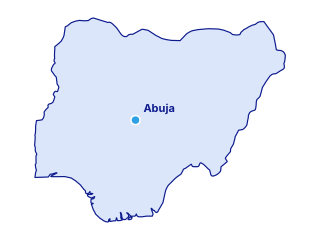
A 225+ Million Market That’s Still Growing
Nigeria is big in all the ways that matter for business scale.
Population is estimated at around 225–230 million, making Nigeria Africa’s most populous country and one of the top 6 in the world.1
GDP is in the USD 470–500 billion range, depending on exchange rates, placing Nigeria among the top 30 economies globally and the largest in Africa by size.2
GDP grew 3.19% year‑on‑year in real terms in Q2 2024, up from 2.51% in Q2 2023, and above the 2.98% recorded in Q1 2024 — suggesting momentum despite macro headwinds.2
In other words: this is a large, young, structurally growing market — not a niche play.
The Currency Angle: Volatility, Reform, and Export Advantage
The naira has been through one of the most volatile periods in its history — but under that volatility sits a real structural logic.
In 2023, Nigeria unified multiple exchange rates into a single, market‑determined FX window, removing a major distortion and aligning the official market more closely with reality.3
Between 2023 and 2024, the naira saw sharp depreciation and extreme volatility, but recent reforms — clearing around USD 7 billion in FX backlogs, tightening oversight of banks’ dollar positions, and new rules for oil company repatriation — have been aimed at stabilising the market and improving liquidity.4
A weaker, more market‑aligned naira makes Nigerian exports (goods and services) more price‑competitive globally; exporters earn in USD/EUR while paying costs in naira, widening margins if they can manage the volatility.3
For businesses, the naira is not a “set‑and‑forget” currency — but for export‑oriented or FX‑earning models, it can be a structural cost advantage if risk is managed well.
What Nigeria Brings to the Table
Nigeria’s economy is often labelled “oil‑dependent”, but the structure is much more diversified.
Services: The New Engine
As of 2024, services account for around 56.9% of real GDP output, making services the dominant contributor to economic activity.5
In Q2 2024, the services sector grew 3.79% and contributed 58.76% to aggregate GDP — the main driver of overall growth.2
Key subsectors include trade, ICT, finance, real estate, transport, and hospitality, with ICT and financial services particularly important in Lagos and Abuja.1
Nigeria is no longer just “oil + agriculture”; it’s increasingly a services economy with a strong urban commercial core.
Agriculture: The Backbone of Jobs and Rural Demand
Between 2021 and 2024, agriculture contributed about 28% of GDP and employed around 40% of the labour force.6
The sector includes crops (about 85% of agricultural GDP), livestock, fisheries, and forestry, with major outputs in cassava, yams, rice, maize, and livestock products.6
Agricultural GDP grew about 2.9% annually over 2021–2024, with policy support through the National Agricultural Technology and Innovation Policy (NATIP) focused on value chains, mechanisation, irrigation, and climate‑smart practices.6
For agri‑businesses, inputs, processing, logistics, and tech, Nigeria is one of the largest “under‑modernised” markets in the world.
Industry: From Negative to Positive Growth
Industry (including manufacturing, construction, and oil & gas) contributed roughly 23–25% of GDP, with oil and gas a smaller share of total output than many assume.1
In Q2 2024, the industry sector grew 3.53%, a sharp improvement from the ‑1.94% contraction recorded in Q2 2023.2
Manufacturing and construction are heavily tied to domestic demand and infrastructure spending, with special economic zones and industrial parks trying to catalyse new investment.7
Industrial output is recovering from previous shocks, and policy is increasingly targeted at manufacturing, agro‑processing, and export‑oriented zones.
Ease of Doing Business: Hard Work, But Improving Pockets
Nigeria as a whole still ranks low on global ease‑of‑doing‑business type measures, but the story is uneven — and changing.
Historically, Nigeria ranked around 131st in the World Bank Doing Business index, with major pain points in electricity, enforcing contracts, and trading across borders.8
However, Nigeria improved by 39 places in aggregate between 2016 and 2020, one of the largest jumps in that period.9
Subnational assessments show significant differences:
Lagos, Kaduna, Oyo, Abuja (FCT), Ogun, and Kano are among the top performers on state‑level “ease of doing business” composite scores.9
Reforms at federal and state level include:
Company registration portals and CAC modernisation
Consolidation of permits and licences in some states
Attempts to streamline tax administration and reduce multiple taxation5
In practice: Nigeria is not a “plug‑and‑play” business environment — but specific states and sectors are becoming meaningfully easier to operate in than the legacy narrative suggests.
A Scale Platform for Those Who Can Handle Complexity
Nigeria’s platform value comes from a simple combination that’s hard to replicate:
A 225+ million‑person market today, with projections around 400 million by 2050.6
A GDP near USD 500 billion and growing around 3% annually, with services now the main growth engine.5
Agriculture contributing nearly 30% of GDP and employing 40% of workers — a vast space for productivity, logistics, and tech transformation.6
An industry base moving from contraction to growth, with policy attention on manufacturing and processing.7
A currency that, while volatile, structurally makes naira‑cost operations attractive for FX‑earning businesses.4
Nigeria is not the right platform for companies that need perfect stability and zero friction. It is the right platform for those who can handle complexity in exchange for scale, cost advantage, and early‑mover position in Africa’s largest market.
Aculeap exists for one reason — to make sure you’re on the right side of that bridge.
The platform is open. Are you ready to build on it?
Is Nigeria Right for My Business?
Nigeria market entry FAQ
Is Nigeria too risky to bother with as a foreign SME?
It’s high‑risk and high‑reward. Nigeria offers a 225–230 million‑person market, GDP around USD 470–500 billion, and services now driving nearly 60% of output — with real GDP growing above 3% in 2024 despite turbulence.25 But FX volatility, infrastructure gaps, and regulatory complexity are real. If you need low‑friction, predictable operations as a non‑negotiable, Nigeria may not be your first node. If you can handle complexity in exchange for scale, cost advantage, and early‑mover position, it belongs in the conversation.
Should we think of Nigeria as a domestic market play or a regional hub?
Both, but with different timeframes. In the near term, Nigeria is overwhelmingly a domestic scale play — Lagos and a handful of key states give you one of the world’s largest urban consumer and services markets.25 Over time, as AfCFTA and regional infrastructure improve, Nigeria can function as a West African hub for production, logistics, and digital services into ECOWAS and beyond. We design your entry so you can capture domestic scale first, with optionality for regional expansion later.
Is the naira’s volatility a deal‑breaker?
It’s a design constraint, not an automatic deal‑breaker. Since 2023, Nigeria unified multiple exchange rates into a single FX window and has been clearing legacy backlogs, tightening bank FX practices, and reforming repatriation rules.34 The result is a more market‑aligned, but still volatile, naira. For import‑dependent, naira‑only businesses, FX volatility is painful. For exporters and FX‑earning companies, a weaker naira can be a structural advantage: you earn in USD/EUR, pay most costs in naira, and expand margins if you manage hedging and cash‑flow timing intelligently.34
Can we freely repatriate profits from Nigeria?
Yes, if you structure correctly from day one. A properly registered foreign‑owned company that brings capital in through the banking system and obtains a Certificate of Capital Importation (CCI) can repatriate dividends and capital through official channels. The FX market can still be tight at times, but the legal right is there. If you skip the CCI step or rely on informal flows, you lose both legal protection and repatriation priority. We make CCI and FX strategy non‑negotiable parts of your setup.310
Can foreigners own 100% of a Nigerian company?
Yes. Foreign investors can own up to 100% equity in Nigerian companies in most sectors, except in restricted areas like arms, narcotics, and some defence‑related activities. The most suitable form for foreign investors is a Private Company Limited by Shares (Ltd), which allows full foreign ownership and limited liability.11
Can we just operate our existing foreign company “as is” inside Nigeria?
No. Under the Companies and Allied Matters Act (CAMA) 2020, any foreign company intending to “carry on business” in Nigeria must first incorporate a separate local entity with the Corporate Affairs Commission (CAC). You cannot legally operate in Nigeria solely through a foreign entity; you must register a Nigerian company or branch, then obtain the relevant permits.3
What is the minimum capital for a foreign‑owned company?
New guidelines from the Ministry of Interior mandate a minimum authorised share capital of ₦100 million for companies with foreign participation. This is a policy lever to ensure only serious investors enter and to align with business permit and expatriate quota requirements. In practice, this translates into higher initial capitalisation and registration costs (often ₦3–3.5 million including professional fees), but it also signals seriousness to banks and regulators.3
What are the key steps to incorporate a foreign‑owned company in Nigeria?
Name reservation — Propose 2+ names and reserve via the CAC portal (60‑day hold).
Prepare documents — Memorandum & Articles of Association, director/shareholder details, IDs, foreign certificate of incorporation (if a corporate shareholder), board resolution, proficiency certificates (for regulated professions).
Online incorporation — File pre‑registration forms via CAC, pay filing fees and stamp duty based on share capital.
Certificate of Incorporation — CAC issues electronic Certificate, stamped MoA/AoA, and Status Report; typical timeframe 1–2 weeks depending on workload.
Business Permit & Expatriate Quota — Apply to the Ministry of Interior for business permit and expatriate quota if you will employ foreigners.
NIPC Registration — Register with the Nigerian Investment Promotion Commission as a foreign investor.
Tax & VAT Registration — Register with FIRS for TIN, corporate tax, and VAT.
Bank Account & CCI — Open a local bank account, import capital through the banking system, and obtain a Certificate of Capital Importation.
We manage this as a single programme with local legal and corporate‑services partners.
What are the main regulators and registrations we have to deal with?
At minimum, a foreign‑owned operating company will engage with:1210
CAC — Corporate Affairs Commission (incorporation and changes)
NIPC — Nigerian Investment Promotion Commission (foreign investment registration)
FIRS — Federal Inland Revenue Service (corporate tax, VAT, withholding tax, TIN)
Ministry of Interior — Business Permit and expatriate quota
State tax authorities — For certain local taxes and levies
Sector regulators — For regulated industries (NCC for telecoms, CBN for financial services, NUPRC for upstream oil and gas, etc.)
Nigeria’s complexity is real. Our job is to turn it into a known calendar and checklist, not a constant surprise.
What taxes will our Nigerian entity pay?
Companies Income Tax (CIT) — 30% on taxable profits for large companies; 20% for medium‑sized; micro‑ and small companies below certain thresholds may pay 0% CIT.
Value Added Tax (VAT) — 7.5% on most goods and services; companies are VAT collection agents for FIRS once registered.
Withholding Tax (WHT) — 5–10% on specified payments (dividends, interest, royalties, services), often creditable against CIT.
Personal Income Tax — PAYE for employees, administered by state tax authorities.
Sector‑specific levies (education tax, NITDA levy for qualifying tech companies, etc.) in some cases.
We structure your intercompany flows and pricing to manage total effective tax, not just headline rates.
Nigeria ranks poorly on ease‑of‑doing‑business indices. Is it uniformly bad?
No — it’s uneven. Nationally, Nigeria has historically ranked around 131st in the Doing Business index, with serious issues in power availability, contract enforcement, and trade logistics.8 But between 2016 and 2020 it climbed 39 places, and sub‑national assessments show that states like Lagos, Kaduna, Oyo, Ogun, Abuja (FCT), and Kano outperform others significantly on business environment metrics.95 We choose your state(s) deliberately based on sector, logistics, and regulatory pragmatism.13
What are the main challenges Nigerian SMEs themselves report?
Common pain points highlighted in surveys and advisory reports include:14
Supply chain inefficiencies and infrastructure gaps (roads, ports, power)
Your competitive advantage as a well‑structured foreign entrant is not avoiding these — it’s designing your model (location, partners, FX, power, logistics) around them.
Which sectors make the most sense for foreign SMEs in Nigeria?
Based on current data and reforms, promising areas include: 5267
Digital & financial services — Fintech, payments, agency banking, SME finance, and adjacent B2B SaaS in Lagos/Abuja
Agriculture & agritech — Inputs, mechanisation, irrigation, storage, cold chain, processing, and marketplace models across major value chains
Logistics & supply chain — Middle‑mile and last‑mile logistics, warehousing, port‑adjacent services
Healthcare, education, and skills — Clinics, healthtech, edtech, and vocational training for a young population
Light manufacturing & processing — FMCG, agro‑processing, and construction materials within industrial zones and SEZs
Our Market Entry Strategy work starts by matching your capabilities to where Nigeria’s structural demand is deepest and most under‑served.
Where should we base operations: Lagos, Abuja, or elsewhere?
For most foreign SMEs, Lagos is the default — it’s the financial and commercial capital, home to most banks, tech companies, and corporate HQs.7 Abuja is critical for government and policy‑heavy sectors. States like Ogun, Oyo, Kano, and Kaduna make sense for manufacturing, agribusiness, or logistics plays given their industrial clusters and relative reform momentum.95 We often recommend a Lagos corporate base with operational footprints in one or two other states depending on your sector.
What does the visa and expatriate framework look like for foreign founders and staff?
Foreign‑owned companies must obtain a business permit from the Ministry of Interior and an expatriate quota specifying how many foreign employees they can legally hire. Individual foreign staff then obtain a Combined Expatriate Residence Permit and Aliens Card (CERPAC) tied to that quota. This system is workable but bureaucratic; we coordinate immigration and quota planning with local counsel so it doesn’t become a last‑minute blocker.3
Is it hard to build and retain a good local team?
Yes — but not impossible. PwC’s MSME Survey and multiple SME reports highlight two critical pressures: talent emigration, especially among mid‑career professionals, and the cost of maintaining competitive compensation in a volatile macro environment. The flip side: Nigeria has a very young, entrepreneurial population, robust tech and creative ecosystems in Lagos, and strong local professional networks. We help you design a mixed team model (local core plus regional/remote support) and, where appropriate, use fractional or regional leadership instead of large upfront headcount in‑country.15
What does Aculeap actually do for Nigeria entry and scaling?
Market Entry Strategy — Determine if Nigeria makes sense for your risk profile, capital, and corridors; pick initial states, sectors, and customer segments.
International Corporate Structuring — Coordinate CAC incorporation, NIPC registration, business permit and expatriate quota, tax/VAT registration, banking, and CCI/FX architecture.
GTM Execution — Design your Nigeria GTM (Lagos‑first or sector‑specific), identify and vet local partners, and structure your sales, distribution, or platform strategy.
AI Growth Engine — Use AI to map accounts, ecosystems, and talent in Nigeria, and to prioritise pipelines that justify the complexity.
Fractional Executive Network — Where appropriate, deploy regional or Nigeria‑experienced fractional leaders to avoid “flying blind” in a complex market.
How do we get started with Aculeap for Nigeria?
Book a 30‑minute Nigeria discovery call. We’ll map your current markets, risk tolerance, and capital position against where Nigeria can realistically fit — and give you a candid view of whether to treat it as a first‑wave, second‑wave, or later‑wave node in your global architecture.
Sources
- en.wikipedia — en.wikipedia.org
- nigerianstat.gov — nigerianstat.gov
- linkedin — www.linkedin.com
- foakinrele
- app.nesgroup — app.nesgroup
- fao — www.fao.org
- lagoschamber
- archive.doingbusiness — archive.doingbusiness
- youtube — www.youtube.com
- business-sweden
- afsic
- dhl
- pwc
- GDP & GDP per capita: International Monetary Fund, World Economic Outlook (2025–26 estimates). imf.org
- Population: national statistical offices / United Nations (latest official estimate). population.un.org
- Safety — Global Peace Index 2025: Institute for Economics & Peace. economicsandpeace.org
- Safety — Safety Index 2026: Numbeo. numbeo.com
- Corporate tax (statutory headline rate): KPMG corporate tax rate tables. kpmg.com
- Trade agreements: national trade ministries / WTO Regional Trade Agreements database. wto.org
Country-snapshot figures reflect the latest available data (2024–2026) from the sources above; FX rates are live or pegged as noted. Figures are drawn from the sources above and reflect the latest available data at time of writing; we refresh market guides periodically. They are provided for general guidance and are not legal, tax, or financial advice.