
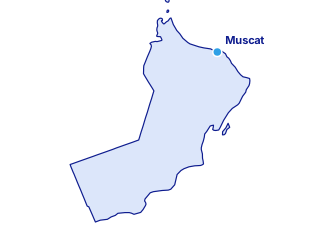
A Small Economy with a Big Structural Shift
Oman is not a giant by size, but its trajectory matters.
At constant prices, Oman’s GDP reached about OMR 37.7 billion (roughly USD 98 billion) in 2024, growing 1.6% year‑on‑year despite weaker oil prices. Government figures show that by 2024, non‑oil activities represented around 73% of the economy at constant prices — a significant structural shift away from pure hydrocarbon dependence.1
The World Bank estimates real GDP growth at 2.6% in 2025, driven primarily by non‑oil sectors, and projects growth of around 2.4–2.6% in 2026 as hydrocarbon output stabilises and non‑oil activities continue to expand. Fitch, S&P, and Moody’s have all upgraded Oman back to investment‑grade status, reflecting improved fiscal and external positions.2
In simple terms: Oman is moving from “oil story” to “balanced small economy with improving fundamentals”.
The Currency Angle: One of the World’s Strongest Pegs
The Omani rial (OMR) is one of the strongest and most stable currencies in the world — and that stability is by design.
The OMR is tightly pegged to the US dollar at roughly 1 OMR = 2.6008 USD (US$1 ≈ 0.3845 OMR) and has maintained this peg for decades.3
This peg gives Oman’s monetary system dollar‑like stability, anchoring inflation and providing predictability for importers, exporters, and investors.3
For businesses, contracts denominated in OMR effectively behave like contracts in a strong, stable dollar‑linked currency — reducing FX risk across long‑term projects and investments.4
In a region where currency risk can complicate planning, Oman’s dollar peg offers a rare level of monetary predictability.
What Oman Brings to the Table
Oman’s economy blends hydrocarbons with an increasingly important non‑oil base anchored in logistics, industry, and services.
Hydrocarbons – Oil and gas still matter: in early 2025, oil activities grew 6.8% year‑on‑year, supporting overall GDP growth as prices recovered. Hydrocarbons underpin fiscal revenues but no longer dominate total output to the extent they once did.5
Non‑Oil Sectors – Non‑oil activities — including manufacturing, construction, trade, logistics, tourism, and services — now account for around 73% of real GDP. The World Bank notes that non‑oil growth is the main driver of projected 2.4–2.6% growth in 2025–26.6
Logistics & Ports – Oman’s ports at Duqm, Sohar, and Salalah sit directly on the Indian Ocean, outside the Strait of Hormuz chokepoint. This gives companies operating from Oman direct blue‑water access to East Africa, India, and Southeast Asia — a strategic advantage for shipping and trans‑shipment.6
Construction & Real Estate – Construction is a key growth driver, backed by government and private investment in industrial zones, tourism infrastructure, and housing. Residential property prices rose 7.3% year‑on‑year in Q1 2025, reflecting active real estate markets.5
Industrial & Non‑Oil Exports – Credit Oman reports that insured non‑oil exports reached OMR 61.2 million in Q1 2025, up 6% year‑on‑year, driven by construction materials, petrochemicals, mining products, and agricultural goods.5
Oman is positioning itself as a logistics and industrial complement to larger Gulf economies — with less congestion, lower profile, and direct ocean access.
Operating Environment: Improving Fundamentals and Predictability
Oman ranked around 68th in the World Bank’s Ease of Doing Business index before the series was discontinued — behind some peers but not dramatically so. What matters more is the direction of travel.7
According to the World Bank and rating agencies:8
Fiscal position – Oman’s fiscal balance moved from deficit into a small surplus of about 0.7% of GDP in 2025 thanks to reforms, spending discipline, and improved non‑oil revenue.
Debt and financing – Sovereign risk has improved; Moody’s upgraded Oman to investment grade (Baa3) in 2025 with a stable outlook, and Fitch raised Oman to BBB, supporting better market access and lower funding costs.2
Inflation – Inflation remains low, at around 0.8–0.9% in 2024–2025, with medium‑term projections around 2% — a stable environment for cost planning.2
Labour market – Unemployment has been trending downward, reaching around 3.6% by late 2024, according to the National Centre for Statistics and Information.6
Add to this a legal and regulatory environment that is more predictable than many emerging markets, and Oman starts to look like a relatively low‑volatility base in a region often associated with higher risk.
A Platform Between the Gulf, Africa, and South Asia
Oman’s real edge is geographic and strategic rather than purely numerical.
From an Omani base, companies can:
Serve GCC markets via customs and regulatory frameworks, while operating from a jurisdiction that is often perceived as quieter and less politically prominent than some neighbours.6
Use Duqm, Sohar, and Salalah as logistics hubs for flows between the Gulf, East Africa, India, and the wider Indian Ocean, avoiding some of the chokepoints that constrain other Gulf ports.6
Price projects and contracts in a dollar‑pegged currency that offers high stability, while benefiting from an improving fiscal and credit profile.7
Plug into a non‑oil economy that already accounts for nearly three‑quarters of GDP, with growing opportunities in construction, industry, services, and tourism.1
For many firms, Oman functions best as a regional node — a place to base logistics, industrial operations, or specialised services that support a wider Gulf, Africa, and South Asia strategy, rather than a standalone mega‑market.
Oman is not trying to be Dubai or Riyadh. It’s building something more focused: a stable, dollar‑pegged, strategically located platform with improving macro fundamentals and a growing non‑oil base.
For companies that value predictability, location, and quiet strength over headlines, that combination is compelling.
Aculeap exists for one reason — to make sure you’re on the right side of that bridge.
The platform is open. Are you ready to build on it?
Is Oman Right for My Business?
Oman market entry FAQ
Oman is small. Why would we use it as a base at all?
Because the question isn’t “How big is the domestic market?” — it’s “Where can we place a stable, dollar‑pegged, strategically located node between the Gulf, Africa, and South Asia?” Oman’s GDP is around USD 100 billion, but non‑oil now accounts for roughly 73% of output, fiscal and credit ratings have been upgraded back to investment grade, and its ports sit directly on the Indian Ocean, outside chokepoints like the Strait of Hormuz.186 For logistics, light industry, regional services, and project bases, the platform is bigger than the headline number suggests.
How does Oman compare to the UAE as a base?
The UAE wins on global visibility, free‑zone variety, and capital markets; Oman wins on being quieter, less congested, and strategically well‑placed for blue‑water shipping to East Africa and India.69 UAE company setup is more mature and heavily marketed; Oman’s is improving fast but still requires more navigation. For many SMEs, Oman is best as a lower‑profile, cost‑sane node in a broader Gulf and Indian Ocean strategy — not a replacement for Dubai, but a complement.
What is the currency situation — is the rial stable?
Extremely. The Omani rial (OMR) is tightly pegged to the USD at around 1 OMR = 2.6008 USD and has maintained that peg for decades.34 This gives you dollar‑like stability in a small Gulf economy: contracts in OMR effectively behave like strong USD‑linked contracts, with low FX risk across multi‑year projects. In a region where some currencies can move sharply, that stability is a real asset.
What corporate tax and VAT will our Omani entity face?
The standard corporate tax rate in Oman is 15% on taxable profits. VAT is currently 5% on most goods and services. Free‑zone companies engaged in qualifying industrial or export activities can access multi‑year corporate tax holidays (initial 10 years, extendable up to 30 years for strategic projects), plus customs and VAT relief on qualified imports and re‑exports. We structure you so your operations match the incentives — not the other way around.1011
Are there meaningful tax incentives in free zones vs. mainland?
Yes. Free zones and special economic zones (Duqm, Sohar, Salalah, and others) offer:12
10‑year corporate income tax holidays, extendable for strategic activities
100% customs duty exemption on imported machinery, raw materials, and equipment
VAT zero‑rating or suspension on goods moving in and out of free zones for export
Mainland entities pay the standard 15% CIT, but can trade freely in the local market without customs friction. The right choice depends on whether you’re targeting Oman’s domestic market or using Oman as an export/logistics base.
What’s the practical difference between a mainland company and a free zone company in Oman?
Registered with MoCIIP (Ministry of Commerce, Industry & Investment Promotion)
Can trade anywhere in Oman and bid for public and private contracts
Standard 15% corporate tax, 5% VAT, and standard customs rules
Registered under OPAZ (Public Authority for Special Economic Zones and Free Zones)
100% foreign ownership, focused on export, logistics, and industry
Long tax holidays, customs/VAT relief, and simplified import–export processes
Limited direct trading with mainland without appointing a local distributor or paying customs/VAT
For most export‑oriented or industrial plays, free zones are the logical base. For local services, retail, or projects that require direct domestic contracts, mainland is essential.
Can a free zone company sell into the Oman mainland market?
Yes — but with conditions. Free‑zone entities can sell into the mainland if they:13
Appoint a mainland distributor/agent, who imports and sells locally
Or pay applicable customs duties and VAT when goods enter the mainland customs territory
Direct, large‑scale mainland sales from a free‑zone entity defeat the purpose of the free‑zone tax/customs structure. If you see meaningful domestic revenue in your model, we’ll typically recommend a dual structure: free‑zone manufacturing/logistics plus a lean mainland sales entity.
Do we need a local Omani partner, or is 100% foreign ownership allowed?
Historically, Oman required local ownership. Today, Oman allows 100% foreign ownership in many sectors, especially under free‑zone regimes and for certain mainland activities following recent reforms. Some regulated sectors (banking, telecom, strategic resources) still have restrictions. We confirm the ownership rules for your specific activity and structure you accordingly.141113
What is the minimum capital required to set up a company in Oman?
Minimum capital requirements vary by structure and ownership mix:15
For Omani or GCC‑only shareholding: OMR 20,000 minimum capital in many cases
For foreign–Omani mixed shareholding: OMR 150,000 minimum is common
Free‑zone minimum capital requirements may differ by zone and activity; some zones effectively have no minimum for certain service companies, while industrial projects need higher capital
We design your capitalisation to meet legal requirements and banking/credibility expectations without over‑committing capital unnecessarily.
How long does it take to set up a company in Oman?
For free zones, most advisors quote 1–4 weeks from document submission to licence issuance, depending on the zone and completeness of documents. Mainland LLC registration via MoCIIP and the Oman Business Platform generally takes a few weeks: name reservation, CR issuance, OCCI registration, and tax registration. We typically advise clients to plan for 4–8 weeks from decision to “operational”, including bank account opening and basic compliance setup.1112
What documents and steps are involved in company registration?
For free‑zone formation, expect: business plan, board resolution, MoA/AoA, passport/visa copies, specimen signatures, proof of address, bank reference, lease agreement, and completed application forms. Mainland LLCs follow a similar path: select activity and structure, reserve trade name, prepare MoA/AoA, submit to MoCIIP, obtain Commercial Registration (CR), register with OCCI, obtain Tax Registration Number, then register with labour and municipality authorities. We run this process end‑to‑end with local partners.12
Is opening a corporate bank account in Oman difficult for foreign-owned companies?
Easier than some regional peers, but still documentation‑heavy. Omani banks will expect: company documents (CR, MoA/AoA, licences), shareholder IDs, KYC/source‑of‑funds evidence, and in some cases a local signatory or presence. The process usually runs in parallel with company registration and can take a few weeks. We coordinate bank selection and onboarding so you’re not losing time once the legal entity is live.13
Do we need to be residents to own and manage an Omani company?
You do not need to be an Omani or GCC resident to own an Omani company; 100% foreign ownership is possible in many sectors. However, if you want to live in Oman and manage operations on the ground, you’ll need an appropriate investor or employment visa tied to the company. We align your corporate structure with your residency plans and work with local immigration advisors where needed.141113
What are the main ongoing compliance obligations?
Key obligations include:141113
Corporate income tax filing at 15% (unless exempt under free‑zone rules)
VAT registration and 5% returns if above the threshold and required by your activity
Labour law compliance — contracts, Omanisation quotas, end‑of‑service benefits
Free‑zone‑specific reporting and activity compliance (for tax holidays to remain valid)
Oman is marketed as business‑friendly — which is true — but like everywhere in the Gulf, non‑compliance catches up quickly. We implement a compliance calendar and connect you to local accountants and legal support.
Is Oman mainly a domestic market or a regional platform?
Realistically: a regional platform with a modest domestic market. Domestic demand (roughly 5 million people) is meaningful but not massive; the real strategic value is in logistics, export, and project work spanning the Gulf, East Africa, and South Asia.65 If your model is manufacturing, distribution, shipping, or specialised services that serve multiple markets, Oman’s ports and location are a real edge.
Which sectors make the most sense for a foreign SME in Oman?
Based on current growth and incentives, strong candidates include: 6110
Construction materials, light manufacturing, and industrial services
Energy‑adjacent services (maintenance, engineering, logistics)
Tourism, hospitality, and niche experiences (especially around coastal and cultural assets)
Professional services that support industrial projects and government initiatives
We assess your category against Omani demand, free‑zone incentives, and regional linkages as part of the entry strategy.
How is selling in Oman different from selling in the UAE or Saudi?
Oman is lower‑key and often more relationship‑driven, with a business culture that values long‑term trust, discretion, and reliability over flash. The government and large local groups remain central to major projects. Sales cycles can be slower but less politicised than in larger Gulf markets. Competition is less intense in many niches, but so is raw demand. We design your Oman GTM as part of a broader GCC/Indian Ocean play, not in isolation.
What does Aculeap actually do for Oman market entry and structuring?
Market Entry Strategy — Validate whether Oman fits your GCC/Indian Ocean strategy, define your role (logistics node, industrial base, project hub), and build a 90‑day roadmap.
International Corporate Structuring — Advise on mainland vs. free zone, set up the entity, handle MoCIIP/OPAZ processes, banking, tax/VAT registration, and compliance calendar.
GTM Execution — Design your Oman GTM as part of your Gulf & Indian Ocean strategy, identify local partners, and structure your sales and project pipeline.
AI Growth Engine — Use AI‑driven market mapping and outreach to identify regional buyers, partners, and project opportunities linked to Oman.
Fractional Executive Network — Place regional executives who understand Oman, the GCC, and India/Africa corridors to lead locally without full‑time cost from day one.
Where does Oman fit in our overall corridor strategy with Aculeap (India, UAE, UK, Canada, etc.)?
For many of your ideal clients, Oman will not be the first node — but it can be a highly effective second or third:
India/Oman/UAE as a combined production + logistics + capital stack
Canada or UK as holding/investor base; Oman as regional operational base
UAE + Oman where UAE is HQ and capital hub, Oman is industrial/logistics hub
Our job is to help you decide if Oman belongs in your architecture and, if yes, design the legal, tax, and GTM structure so it actually works in practice.
If you’d like, next I can create a short “micro‑FAQ” (3–5 quick questions) for each country page — perfect for a sidebar or “Still have questions?” strip.
Sources
- fm.gov — www.fm.gov.om
- thedocs.worldbank — www.worldbank.org
- remitly
- cowrywise
- arabnews — www.arabnews.com
- international.groupecreditagricole — international.groupecreditagricole.com
- en.wikipedia — en.wikipedia.org
- allianz-trade
- muscatdaily
- emerhub
- youtube — www.youtube.com
- commitbiz
- finsoulnetwork
- enterslice
- investroyal
- GDP & GDP per capita: International Monetary Fund, World Economic Outlook (2025–26 estimates). imf.org
- Population: national statistical offices / United Nations (latest official estimate). population.un.org
- Safety — Global Peace Index 2025: Institute for Economics & Peace. economicsandpeace.org
- Safety — Safety Index 2026: Numbeo. numbeo.com
- Corporate tax (statutory headline rate): KPMG corporate tax rate tables. kpmg.com
- Trade agreements: national trade ministries / WTO Regional Trade Agreements database. wto.org
Country-snapshot figures reflect the latest available data (2024–2026) from the sources above; FX rates are live or pegged as noted. Figures are drawn from the sources above and reflect the latest available data at time of writing; we refresh market guides periodically. They are provided for general guidance and are not legal, tax, or financial advice.