
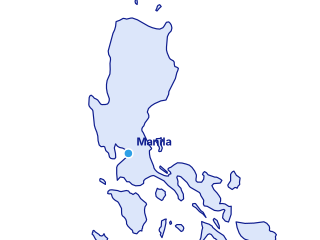
A 115 Million Market Growing Faster Than Most Peers
The Philippines is now one of the larger economies and populations in Asia.
Population is around 115 million, making it the world’s 13th most populous country and a major demographic anchor in ASEAN.1
GDP grew 5.6% in 2024, the second‑highest growth rate in Southeast Asia, with GDP per capita rising to about USD 4,080.2
In Q4 2024, GDP expanded 5.2% year‑on‑year, bringing full‑year growth to 5.6%; industry grew 4.4% and services 6.7% in that quarter.3
The IMF and other forecasters see growth around 5.5–6% in 2025, keeping the Philippines among Asia’s faster‑growing mid‑income economies.2
Household consumption is the main engine: it accounts for about 72.6% of GDP, with government consumption at 15.1%, reflecting a consumption‑driven structure supported by remittances.4
The Currency Angle: Volatile Headlines, Managed Reality
The Philippine peso (PHP) has weakened, but not in a disorderly way.
As of June 2026, USD/PHP trades around 60.7, with expectations for it to be around 60.65 by the end of this quarter.5
Peso depreciation contributed to higher inflation in 2022–2023, but the ASEAN+3 Macroeconomic Research Office (AMRO) finds the impact modest: a 1% peso depreciation raises quarterly inflation by only about 0.046 percentage points, with a one‑year cumulative impact of around 0.09.6
Inflation peaked around 6% in 2023, but moderated to 3.2% in 2024, back within the Bangko Sentral ng Pilipinas (BSP)’s 2–4% target range.6
Looking ahead:
The peso is expected to remain volatile through 2025–2026, but BSP is expected to gradually cut policy rates toward about 4.6% by end‑2025 as inflation stays in range.6
For businesses, peso risk is meaningful but largely within a 5–10% band year‑to‑year, not catastrophic swings.
In practical terms: PHP is a “managed emerging currency” — not rock‑solid, but far from unanchored.
What the Philippines Brings to the Table
The Philippines is structurally a service‑oriented economy with important roles for industry and agriculture.
Services: The Dominant Engine
As of 2024, services contribute about 62.9% of GDP, up from 60.4% in 2019.2
By 2025 estimates, services contribute around 63.8% of GDP.1
Key service components:
BPO and IT‑BPM (call centres, shared services, KPO)
Retail and wholesale trade
Finance, real estate, and business services
Tourism and hospitality4
Remittances:
Remittances from overseas Filipino workers account for roughly 10% of GDP and act as a stabiliser for domestic consumption, even during global shocks.4
This combination makes the Philippines a consumption‑driven, services‑heavy economy with a built‑in foreign‑income buffer.
Industry: Electronics and Manufacturing
Industry contributes about 28–29% of GDP.1
Manufacturing and industry are anchored by:
Semiconductors and electronic products (>40% of exports)
Various manufactured and craft products (~16% of exports)4
In Q4 2024, industry grew 4.4% year‑on‑year, adding materially to overall growth.3
While not as diversified as some peers, the Philippines has a significant role in global electronics supply chains.
Agriculture: Smaller but Still Relevant
Agriculture, forestry, and fishing contribute around 7.9–8.3% of GDP, according to recent data.5
The sector’s share has gradually fallen from double digits, reflecting structural transition, but it remains important for rural livelihoods and food security.7
Agriculture is not the primary growth driver, but it is still a meaningful base for agribusiness, inputs, and logistics.
Ease of Doing Business: Improving but Still Mid-Pack
On formal metrics, the Philippines is mid‑range but improving.
The Philippines ranked 95th out of 190 economies in the World Bank’s Doing Business 2020 index — a significant improvement from 124th in 2018 and 144th in 2009.5
The overall “ease of doing business score” improved from 55.1 in 2016 to 63.1 in 2020; by 2024, a separate index shows a score of 48.49 (different scale), indicating a gradual improvement trend.8
Key reforms include:
The CREATE and CREATE MORE Acts, which reduce corporate income tax (down to as low as 20% for some firms), expand enhanced deductions for power and training costs, and institutionalise hybrid work for up to 50% of staff.2
Streamlined procedures in tax administration and improved digitalisation for business registration and filing.2
In practice: still more bureaucratic than top‑tier hubs, but meaningfully better than a decade ago for corporates that structure correctly.
A Services + Consumption Platform in ASEAN
The Philippines’ platform value rests on three pillars: services exports, domestic consumption, and a strategic position in Southeast Asia.
From a Philippines base, companies can:
Sell into a 115‑million‑person market with rising incomes and one of the youngest populations in the region.1
Tap into one of the world’s largest pools of English‑speaking service talent for BPO, IT‑BPM, and remote operations, paying costs in pesos while billing in USD.4
Use the country’s electronics and manufacturing base to participate in regional supply chains, especially for semiconductors and consumer electronics.4
Benefit from a macro mix of:
5–6% GDP growth
Moderating inflation within a 2–4% target range
A central bank actively managing inflation and FX
A reform programme aimed at making corporate taxation more competitive6
The Philippines is not the easiest place administratively, nor the most stable currency, but it offers a large, growing, service‑heavy, consumption‑driven platform in ASEAN — especially for companies that rely on human capital and remittance‑supported demand.
Aculeap exists for one reason — to make sure you’re on the right side of that bridge.
The platform is open. Are you ready to build on it?
Is the Philippines Right for My Business?
Philippines market entry FAQ
Is the Philippines just OFWs and call centres, or a real scale platform?
The Philippines is a 115‑million‑person, lower‑middle‑income economy growing around 5.5–6% annually, with GDP per capita about USD 4,000 and one of the youngest populations in Asia.12 Services now contribute about 63% of GDP, industry roughly 28–29%, and agriculture under 10%, making it structurally a services‑ and consumption‑driven market supported by remittances and BPO exports.214 If you care about human capital and domestic demand, it is one of ASEAN’s most interesting mid‑income stories.
Is this primarily a domestic market play, an export‑services hub, or both?
Both, with services doing double duty. Domestically, household consumption accounts for roughly 72–73% of GDP, powered by remittances equal to about 10% of GDP that support spending even in downturns.42 Externally, BPO/IT‑BPM services and electronics exports make the Philippines a major services and electronics‑manufacturing exporter, so you can earn in USD while paying costs in pesos.34 The right design uses the Philippines as a services engine plus consumption market, not just a cheap back office.
How risky is the Philippine peso (PHP)?
PHP has weakened, but in a controlled way. As of mid‑2026, USD/PHP is around 60.7, with expectations for a similar level at quarter‑end.5 AMRO’s analysis finds that a 1% depreciation raises quarterly inflation by only about 0.046 percentage points, with a one‑year impact of ~0.09 — modest by emerging‑market standards.6 Inflation peaked near 6% in 2023 but fell back to 3.2% in 2024, inside the Bangko Sentral ng Pilipinas (BSP) 2–4% target band, and BSP is expected to gradually cut policy rates as inflation stays contained.6
Net: PHP is a managed emerging currency where typical swings are in the 5–10% annual band, not free‑fall territory.
How does this FX behaviour shape business models?
For BPO/IT‑BPM, SaaS, and export manufacturers, you earn in USD/EUR while paying salaries and local costs in PHP, so gradual depreciation supports margins as long as inflation stays anchored.64 For domestic‑only peso businesses with dollar‑linked inputs, FX is a constraint, so we emphasise models where you either:
Keep FX exposure small and price in regular adjustments.
Can foreigners own 100% of a Philippine company?
Yes — but with important caveats. The Foreign Investment Act (FIA) and constitutional rules set sector‑specific limits:
If foreigners own more than 40% of a domestic, local‑market‑oriented corporation, the FIA normally requires at least USD 200,000 paid‑up capital, unless the company is export‑oriented or qualifies for specific exemptions.9
Export enterprises with at least 60% of sales abroad can often be 100% foreign‑owned with lower capital thresholds.10
Some sectors (mass media, small‑scale mining, certain land ownership) restrict or prohibit foreign equity.11
So 100% ownership is absolutely possible, but you must align capital and sector with the rules.
What legal structures are available to foreign investors?
Domestic Corporation — Separate Philippine company; can be 100% foreign‑owned in many sectors, subject to FIA and sector caps.
One‑Person Corporation (OPC) — Single‑shareholder corporation; also open to foreigners, with the same foreign‑ownership rules and capital thresholds.
Branch Office — Extension of a foreign company; must remit USD 200,000 in capital (lower if advanced technology or 50+ employees).9
Representative Office — Non‑revenue‑generating; needs at least USD 30,000 annual inward remittance.10
Regional HQ / ROHQ — For coordinating regional operations; require initial investments of USD 50,000–200,000.10
Most foreign SMEs aiming for local and export business use a domestic corporation (or OPC) with 100% foreign ownership, calibrated to the USD 200,000 rule, or a branch if they want to operate directly as a foreign entity.
How long does incorporation take and what are the steps?
A standard domestic corporation setup takes 1–3 months in practice, faster with the online SEC system. Core steps:12
Name reservation via the SEC’s eSPARC system.
Prepare and submit documents — Articles of Incorporation, By‑laws, Treasurer’s Affidavit, and IDs/board resolutions for foreign shareholders.10
SEC registration — Issuance of Certificate of Incorporation and corporate Tax Identification Number (TIN).
Barangay Clearance — From the local barangay.
Mayor’s Business Permit — From the city/municipality.
BIR registration — Official TIN activation, authority to print receipts/invoices, and books of accounts.12
Employer registrations — Social Security System (SSS), PhilHealth, and Pag‑IBIG.12
Standard minimum paid‑up capital for a corporation is PHP 5,000, but FIA rules mean USD 200,000 for many foreign‑owned local market enterprises, unless export‑oriented or qualifying for reduced thresholds.11
We structure the project so capital, sector, and ownership fit together cleanly.
Can foreign founders live and work in the Philippines to run their company?
Yes, but you need the right visas and permits. Foreign nationals employed or acting as officers generally must obtain an Alien Employment Permit (AEP) from the Department of Labor and Employment and then a suitable visa, such as a 9(g) pre‑arranged employment visa or a 47(a)(2) special non‑immigrant visa. For investors, the Special Investor’s Resident Visa (SIRV) is available for qualifying investments, typically above USD 75,000. We align your corporate structure and capital with the immigration path you want.11
What’s the corporate tax situation, especially after CREATE/CREATE MORE?
Regular corporate income tax has dropped from 30% to 25%, and as low as 20% for small domestic corporations with net taxable income not exceeding PHP 5 million and total assets under PHP 100 million.2
It introduced enhanced deductions for power, R&D, training, and labour costs, and aligned incentive regimes under BOI and economic zones.2
Combined with territorial incentive regimes (PEZA, BOI), the effective tax rate for export‑oriented firms can be highly competitive. Standard VAT is 12%; zero‑rating is available for qualified export activity.2
What are the main compliance burdens?
Multiple registrations (SEC, BIR, LGU, SSS, PhilHealth, Pag‑IBIG).
Numerous tax payments and filings, especially if operating in multiple LGUs.13
Sector‑specific licences (BSP for finance/fintech, SEC for some services, PEZA/BOI for incentives).
Philippines improved from 144th in Doing Business 2009 to 95th in 2020, but remains mid‑pack; the business environment is notably better than a decade ago, but still more bureaucratic than Singapore or Hong Kong.58 We handle process design and local partners so you aren’t buried in forms.
What are the main challenges foreign SMEs face on the ground?
Complex regulatory framework and overlapping national/LGU rules.
Infrastructure gaps, traffic and logistics issues, and vulnerability to natural disasters.
Competition for talent in BPO/IT‑BPM hubs.
Policy uncertainty in some sectors and evolving interpretations of foreign‑ownership rules.
The upside is that reforms (CREATE, liberalised foreign‑investment rules in some sectors) and a strong private sector push are gradually improving the ecosystem.214
Which sectors make the most sense for foreign SMEs?
Given the structure of the economy, compelling lanes include: 415
BPO, IT‑BPM, and remote services — Call centres, KPO, shared services, and specialised B2B services, leveraging English‑speaking talent.
Software, SaaS, and digital platforms — Especially those serving global clients or local SMEs in fintech, e‑commerce, and logistics.
Semiconductors and electronics — Niche manufacturing, testing, and support around established electronics clusters.
Consumer and retail plays — Food, e‑commerce, and services targeting a young, urbanising population.
Education and healthcare services — Private education, e‑learning, and health services for a growing middle class.
We map your proposition to these lanes and to whether you should be BPO‑style, domestic consumption‑focused, or a hybrid.
What does Aculeap actually do for Philippines entry and scaling?
Market Entry Strategy — Decide whether the Philippines should be your BPO node, domestic demand market, or regional services hub — and how it fits into your ASEAN and global architecture.
Corporate Structuring — Select the right vehicle (domestic corporation/OPC, branch, RO) and align foreign‑ownership, capital (USD 200,000 rule), and sector rules; manage SEC, BIR, and LGU registrations end‑to‑end.11
Incentives & Zones — Evaluate PEZA/BOI/economic zone options, CREATE/CREATE MORE incentives, and hybrid‑work rules for IT‑BPM companies.
GTM Execution — Build your Philippines GTM around talent hubs (Metro Manila, Cebu, Davao), client corridors (US, Japan, Australia), and real local demand pockets.
AI Growth Engine — Use AI to map clients, partners, and talent pools, and to prioritise business lines that best exploit the Philippines’ services and remittance‑backed structure.
Fractional Executive Network — Plug in Philippines‑experienced, often Filipino, fractional leaders who understand both regulatory and cultural realities.
How do we get started with Aculeap for the Philippines?
Book a 30‑minute Philippines discovery call. We’ll map your services, cost targets, and market ambition against what the Philippines actually offers — and give you a clear view on whether it should be your next BPO node, a consumer‑market bet, or a later‑wave expansion.
Sources
- en.wikipedia — en.wikipedia.org
- eda.admin — eda.admin
- psa.gov — psa.gov
- investopedia — www.investopedia.com
- tradingeconomics — tradingeconomics.com
- amro-asia
- data.worldbank — data.worldbank
- statista
- respicio
- tripleiconsulting
- philippines.incorp — philippines.incorp
- philippines.acclime — philippines.acclime
- worldbank — www.worldbank.org
- franchisealpha
- GDP & GDP per capita: International Monetary Fund, World Economic Outlook (2025–26 estimates). imf.org
- Population: national statistical offices / United Nations (latest official estimate). population.un.org
- Safety — Global Peace Index 2025: Institute for Economics & Peace. economicsandpeace.org
- Safety — Safety Index 2026: Numbeo. numbeo.com
- Corporate tax (statutory headline rate): KPMG corporate tax rate tables. kpmg.com
- Trade agreements: national trade ministries / WTO Regional Trade Agreements database. wto.org
Country-snapshot figures reflect the latest available data (2024–2026) from the sources above; FX rates are live or pegged as noted. Figures are drawn from the sources above and reflect the latest available data at time of writing; we refresh market guides periodically. They are provided for general guidance and are not legal, tax, or financial advice.