
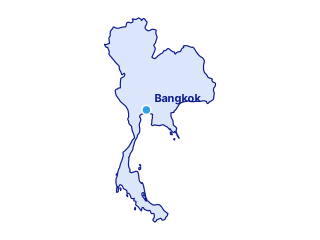
A 70+ Million Market at the Heart of ASEAN
Thailand is mid‑sized by global standards, large by regional ones.
Population is about 71–72 million, making Thailand the second‑largest economy and one of the more populous countries in Southeast Asia.1
GDP (nominal) is around USD 540–550 billion, with PPP GDP around USD 1.3 trillion, placing Thailand in the upper‑middle‑income bracket.2
Real GDP grew 2.5% in 2024, boosted by a rebound in goods exports and a large fiscal stimulus (a THB 10,000 digital cash transfer), offsetting softer private consumption and slower tourism recovery.2
The World Bank expects growth around 1.8–1.9% in 2025–2026 under baseline assumptions, potentially rising toward 2.2% if investment sentiment and public spending accelerate.3
Thailand is not a high‑growth frontier market; it’s a moderately growing, relatively stable anchor in mainland Southeast Asia.
The Currency Angle: Baht as a Regional Risk Gauge
The Thai baht (THB) is one of Asia’s more liquid currencies and often trades as a proxy for regional risk.
The baht has faced steady depreciation pressure; analysts expect it to weaken modestly, for example from around 34.4 to 35.5 per USD over a year, driven by a stronger dollar and global risk‑off sentiment.4
As of mid‑2026, USD/THB trades around 32.9, with the baht down just under 1% over the month — a mild move by emerging‑market standards.5
The Bank of Thailand maintains relatively conservative monetary policy, targeting low inflation (CPI up only 0.4% in 2024, the lowest in four years) and aiming to keep inflation within a 1–3% band.3
For businesses:
THB is not as volatile as some African or Latin American currencies but can move meaningfully with global risk cycles.
Exporters (automotive, electronics, agro‑products, tourism) benefit from a weaker baht, as foreign currency revenues go further in THB terms, while costs remain largely domestic.1
For foreign investors, baht weakness can periodically discount Thai assets in USD terms, while the macro framework remains relatively disciplined.
The baht is best viewed as a managed, moderately volatile regional currency — not a hard peg, not a free‑fall.
What Thailand Brings to the Table
Thailand’s economy is a classic mixed structure: industrial, service, and agricultural pillars all matter.
Industry & Manufacturing: An Export Engine
Thailand is a newly industrialised country with industry and services together accounting for the bulk of GDP; the industrial sector alone accounts for around 39% of GDP by some measures.1
Manufacturing is heavily export‑oriented:
Thailand is ASEAN’s leader in automotive production and sales, a major hub for Japanese and global carmakers.
It is a significant exporter of electronics, computer components, petrochemicals, and machinery.3
Exports are central: in 2021, exports accounted for about 58% of GDP; total exports were roughly USD 495 billion in 2022.1
Industrial Thailand is effectively a regional factory for cars, electronics, and intermediate goods.
Services & Tourism: The Demand and Jobs Driver
Services, including trade, logistics, communications, tourism, and financial services, are the largest contributors to GDP, outpacing agriculture.6
Tourism is a core pillar: Thailand remains one of the world’s top tourist destinations, and tourism‑linked services (hotels, restaurants, transport, retail) are critical to employment and foreign exchange.
Private consumption drives over half of overall growth, supported by government measures like digital wallet programmes and welfare card schemes.2
Thailand’s services sector is both domestic‑demand and export‑oriented (via tourism and logistics).
Agriculture & Agro‑Industry: A Global Food Player
Agriculture produces about 8–9% of GDP, but its export impact is far larger.7
Thailand is a major exporter of:
Rice (long a top global exporter, now competing with India and Vietnam)
Rubber, cassava, sugarcane
Shrimp and other seafood3
Agricultural and agro‑industrial exports reached around USD 52.2 billion in 2024, a 6% increase year‑on‑year.3
For food, feed, and agro‑processing businesses, Thailand is a critical node in global value chains.
Ease of Doing Business: Top 25 Globally
Thailand ranks 21st out of 190 economies in the World Bank’s Ease of Doing Business index — and 9th in Asia in more recent regional rankings.5
Key features:
Starting a business and dealing with permits – Processes have been significantly streamlined over the past decade; electronic systems and one‑stop shops are more common.8
Trade and logistics – As an export‑led economy, Thailand has invested heavily in ports, airports, and customs modernisation.
Financial sector reforms – The 2024 “Ignite Finance” initiative aims to position Thailand as a regional financial hub, focusing on banking, insurance, securities, derivatives, and digital assets, with pillars around future‑ready regulation, incentives, and ecosystem development.8
Tax environment – Corporate tax is competitive; VAT has been kept at a reduced 7% (extended to at least September 2025), and personal tax reforms are ongoing, including new rules for foreign‑sourced income.8
For companies, this means a relatively predictable and increasingly pro‑business regulatory environment, especially compared to many emerging peers.
A Mid‑Size Platform at the Crossroads of Asia
Thailand’s strategic value lies in its geography and integration.
From a Thailand base, companies can:
Serve a domestic market of 70+ million while using Thailand as a production and logistics hub for ASEAN and beyond.7
Plug into regional trade and investment frameworks (ASEAN, RCEP) that tie Thailand to China, Japan, Korea, Australia, New Zealand, and other ASEAN economies.2
Combine manufacturing, tourism, and agro‑industry plays — for example, producing cars or electronics for export while also leveraging tourism and domestic consumption for services revenue.
Operate in an environment with low unemployment (~1%), low and stable inflation, and a relatively disciplined fiscal stance, all of which support predictable business planning.3
Thailand is not the biggest market, nor the fastest‑growing, but it is one of the most versatile: a credible industrial base, strong tourism and services, a serious agro‑export sector, and a business environment consistently in the global top 25.
For companies wanting a balanced, mid‑risk platform in mainland Southeast Asia, Thailand deserves a place much higher on the shortlist than its headlines usually get it.
Aculeap exists for one reason — to make sure you’re on the right side of that bridge.
The platform is open. Are you ready to build on it?
Is Thailand Right for My Business?
Thailand market entry FAQ
Is Thailand just “tourism and cheap manufacturing,” or is there a real platform underneath?
Underneath the clichés is a 71–72 million‑person, upper‑middle‑income economy with GDP around USD 540–550 billion (USD 1.3 trillion on a PPP basis) and three strong pillars: export‑oriented industry, services (including tourism and logistics), and high‑value agriculture.213 Exports are central (around 58% of GDP), with Thailand functioning as a regional factory for cars, electronics, and food products while tourism and private consumption drive demand and jobs.137
Is Thailand a high‑growth frontier play or a stability play?
It’s a moderate‑growth stability play. Real GDP growth was about 2.5% in 2024 and is projected around 1.8–1.9% in 2025–2026 under baseline assumptions, with upside toward ~2.2–2.9% if investment and public spending accelerate.23 That’s slower than Vietnam or Indonesia, but with lower inflation (around 0.4% in 2024), low unemployment (~1%), and a disciplined macro framework, making Thailand attractive for companies that value predictability and diversified sector exposure over sheer growth speed.32
How should we think about the Thai baht (THB) — is it stable or volatile?
The baht is one of Asia’s more liquid currencies and often trades as a proxy for regional risk: it weakens modestly when global risk sentiment sours and strengthens on risk‑on flows.45 Analysts expect gradual depreciation (for example from ~34.4 to ~35.5 per USD over a year), but as of mid‑2026 USD/THB is around 32.9, with monthly moves under 1% — mild by emerging‑market standards.45 The Bank of Thailand targets low, stable inflation (1–3% band), making the baht a managed, moderately volatile regional currency, not a hard peg nor a free‑fall scenario.3
How does this FX profile affect our business model?
Exporters and FX‑earners (automotive, electronics, agro‑exports, tourism) benefit from a weaker baht, as USD/EUR/JPY revenues convert into more THB while costs (labour, rent, local inputs) are mostly baht‑denominated.13 For foreign investors, periods of THB weakness discount Thai assets in USD terms without undermining the macro framework, giving well‑timed entrants a structural cost advantage. We calibrate your pricing, cost base, and capital flows to treat THB moves as an input to your economics, not just noise.
Can a foreigner own 100% of a Thai company?
Generally, no for standard Thai limited companies — under the Foreign Business Act, foreigners are usually limited to 49% ownership, with Thais holding at least 51%. However, there are three main pathways to 100% foreign ownership:9
Foreign Business License (FBL) — Case‑by‑case approval to operate restricted activities with majority foreign ownership.
BOI promotion — Board of Investment incentives that can grant 100% foreign ownership and tax/customs benefits in targeted sectors (tech, manufacturing, certain services).
US–Thailand Treaty of Amity — For US citizens and companies, allowing majority or 100% ownership in many sectors, subject to conditions.
We choose the right path (standard Thai company vs. BOI vs. FBL vs. Treaty) based on your sector, capital, and ownership goals.
What are the main legal structures available to foreign investors?
Thai Limited Company — The standard vehicle; at least 2–3 promoters (older rules required 7, now relaxed), foreign ownership typically capped at 49% unless using BOI/FBL/Treaty mechanisms.
Branch Office — Extension of a foreign company; can be 100% foreign‑owned but limited to approved activities and often requires an FBL.
Representative Office — Non‑revenue‑generating; for market research, sourcing, and liaison.
BOI‑promoted entity — Often structured as a limited company but with BOI status granting foreign‑ownership and tax/custom benefits.
For most SMEs, the practical choice is between a local limited company with Thai majority partners and a BOI‑promoted structure that preserves control.
How long does it take to register a company in Thailand?
Registration of a basic private company can take around 7 days from submission of a complete file, according to recent guides. The steps include: reserving a company name, filing the Memorandum of Association and Articles, registering with the Department of Business Development (DBD), and paying registration fees (about THB 50 per THB 1 million of capital for private companies). However, obtaining a Foreign Business License can take 6+ months, and BOI promotion has its own application timeline. We treat standard registration as a 1–2‑week task and FBL/BOI as multi‑month, parallel processes.4
What are the concrete steps to register a foreign‑owned business?
Name reservation via the DBD system.
Prepare company documents — Memorandum of Association (objectives, capital, shareholders), Articles, list of shareholders, director forms, and declaration of business operation.
Register with DBD — Submit documents, pay registration fees, and obtain the company registration certificate.
Tax registration — Apply for a taxpayer ID within 60 days and register for VAT (7%) once taxable turnover exceeds THB 1.8 million per year.
Licences and sector permits — Depending on your activity (e.g., restaurant licences, import/export licences, FDA licences for food and drugs).
FBL or BOI application — If you seek majority foreign ownership in restricted activities.
Bank account — Open a corporate bank account after registration.
Work permits and visas — For foreign directors and staff, requiring company capital and Thai‑employee ratios.
We manage these as a staged project so you know what’s “Day 1”, what’s “Month 3+”, and what’s optional vs. mandatory.
What capital and staffing do we need to employ foreigners legally?
Standard practice: to obtain a work permit for one foreign employee, a non‑BOI Thai company generally needs THB 2 million fully paid‑up capital and 4 Thai employees per foreigner, plus proper Thai tax and social‑security registrations. BOI‑promoted companies may be exempt from some of these ratios or have more flexible rules, which is why BOI is often crucial if you plan to base senior foreign talent in Thailand.10
Is it easy to hire skilled local talent?
Thailand has a large workforce and strong clusters in automotive, electronics, food processing, hospitality, and healthcare. However, SMEs report challenges around language (Thai is dominant), the need for Thailand‑specific experience in regulated sectors, and competition for bilingual talent. We often recommend a blended model: local operational team, supported by regional or remote expertise, with at least one strong Thai leader or partner on the ground.11
What taxes will our Thai entity face?
Corporate income tax — 20% standard rate.
VAT — 7% (reduced rate extended at least to late 2025) on most goods and services once over the THB 1.8 million threshold.
Withholding taxes — On certain payments to residents and non‑residents (dividends, royalties, services).
Social security contributions — For employees.
BOI‑promoted projects can receive tax holidays, import duty exemptions, and other incentives depending on sector and region. We design your structure to take full advantage of the right incentive set, not just “have a Thai company.”12
What are the main compliance obligations?
A Thai company must: maintain proper accounts, file annual audited financial statements, submit corporate tax returns, comply with VAT and withholding obligations, and keep company information updated with DBD. Non‑compliance can lead to fines and problems with work‑permit renewals. We build a compliance calendar and align you with a local accounting and legal team from day one.13
Which sectors make the most sense for foreign SMEs in Thailand?
Based on the structure of the economy and current policy, strong lanes include: 319
Automotive and industrial supply — Components, automation, and services into Thailand’s automotive and electronics clusters.
Food and agri‑value chains — Processing, branding, logistics, and tech around rice, rubber, cassava, sugar, and seafood.
Tourism, hospitality, and experiences — Tech‑enabled tourism services, niche hospitality, and wellness.
Healthcare and med‑tech — Devices, services, and digital health solutions.
Digital services and e‑commerce — Platforms, logistics tech, and fintech, especially those that connect Thai consumers and SMEs to regional markets.
We map your product to where Thailand has both demand and structural advantage, then pick the right region (Bangkok and Eastern Economic Corridor vs. other clusters).
Where does Thailand fit relative to Singapore, Vietnam, and Indonesia in a regional plan?
Singapore — HQ, treasury, and high‑value services hub.
Thailand — Manufacturing, agro‑processing, tourism, and a mid‑risk, mid‑cost domestic market.
Vietnam/Indonesia — Higher‑growth, lower‑cost production and emerging consumer markets.
Thailand works best as a versatile mid‑risk, mid‑cost platform: credible industrial base, real services demand, and solid agro‑exports, in a business environment consistently ranked top‑25 globally.58
What does Aculeap actually do for Thailand entry and scaling?
Market Entry Strategy — Decide if Thailand should be an industrial base, services node, agro‑hub, tourism play, or some combination — and where it fits in your wider ASEAN plan.
International Corporate Structuring — Choose the right structure (Thai Ltd, BOI‑promoted entity, branch, etc.), manage DBD registration, tax/VAT setup, FBL/BOI applications, and banking.
GTM Execution — Build your Thailand GTM by sector and region, aligning with local clusters (automotive belts, agro‑regions, tourism corridors).
AI Growth Engine — Use AI to identify customers, partners, and talent in Thailand and across ASEAN, and to build a targeted pipeline.
Fractional Executive Network — Plug in Thailand‑experienced or Thai‑speaking fractional leaders to navigate local practice, not just law.
How do we get started with Aculeap for Thailand?
Book a 30‑minute Thailand discovery call. We’ll map your current markets and sector strengths against what Thailand actually offers and give you a clear view on structure, capital, and where Thailand fits in your ASEAN architecture.
Sources
- globaltenders
- worldbank — www.worldbank.org
- lloydsbanktrade — www.lloydsbanktrade.com
- tradingeconomics — tradingeconomics.com
- en.wikipedia — en.wikipedia.org
- nso.go — nso.go
- acclime
- commenda
- thaiembassy
- chandrawatpartners
- thailand.acclime — thailand.acclime
- globallawexperts
- GDP & GDP per capita: International Monetary Fund, World Economic Outlook (2025–26 estimates). imf.org
- Population: national statistical offices / United Nations (latest official estimate). population.un.org
- Safety — Global Peace Index 2025: Institute for Economics & Peace. economicsandpeace.org
- Safety — Safety Index 2026: Numbeo. numbeo.com
- Corporate tax (statutory headline rate): KPMG corporate tax rate tables. kpmg.com
- Trade agreements: national trade ministries / WTO Regional Trade Agreements database. wto.org
Country-snapshot figures reflect the latest available data (2024–2026) from the sources above; FX rates are live or pegged as noted. Figures are drawn from the sources above and reflect the latest available data at time of writing; we refresh market guides periodically. They are provided for general guidance and are not legal, tax, or financial advice.